Walks are more than just a 'quick pee break'. They're a key part of a dog's daily life — affecting its physical health, behaviour and mental wellbeing. Walks that are too short or too infrequent can lead to frustration, destructive behaviour and excess weight.
How long should a dog walk actually last? Are two short outings a day enough? The honest answer depends on the dog in front of you, so below we break down how to match the length and pace of a walk to yours, whatever its age, breed or lifestyle.
What does the length of a dog walk depend on?
There's no single universal answer. Every dog's needs are different, and the length of a walk should take several factors into account
- the dog's age — a puppy, an adult dog and a senior have completely different exercise needs
- breed and energy level — a border collie needs considerably more than a French bulldog
- health — joint disease, heart conditions or obesity can limit activity
- temperament — some dogs are naturally calmer, others need intense exertion
- weather conditions — shorten the walk and stick to shade on hot days, dress the dog appropriately for its breed in frost
Puppy (up to 12 months old)
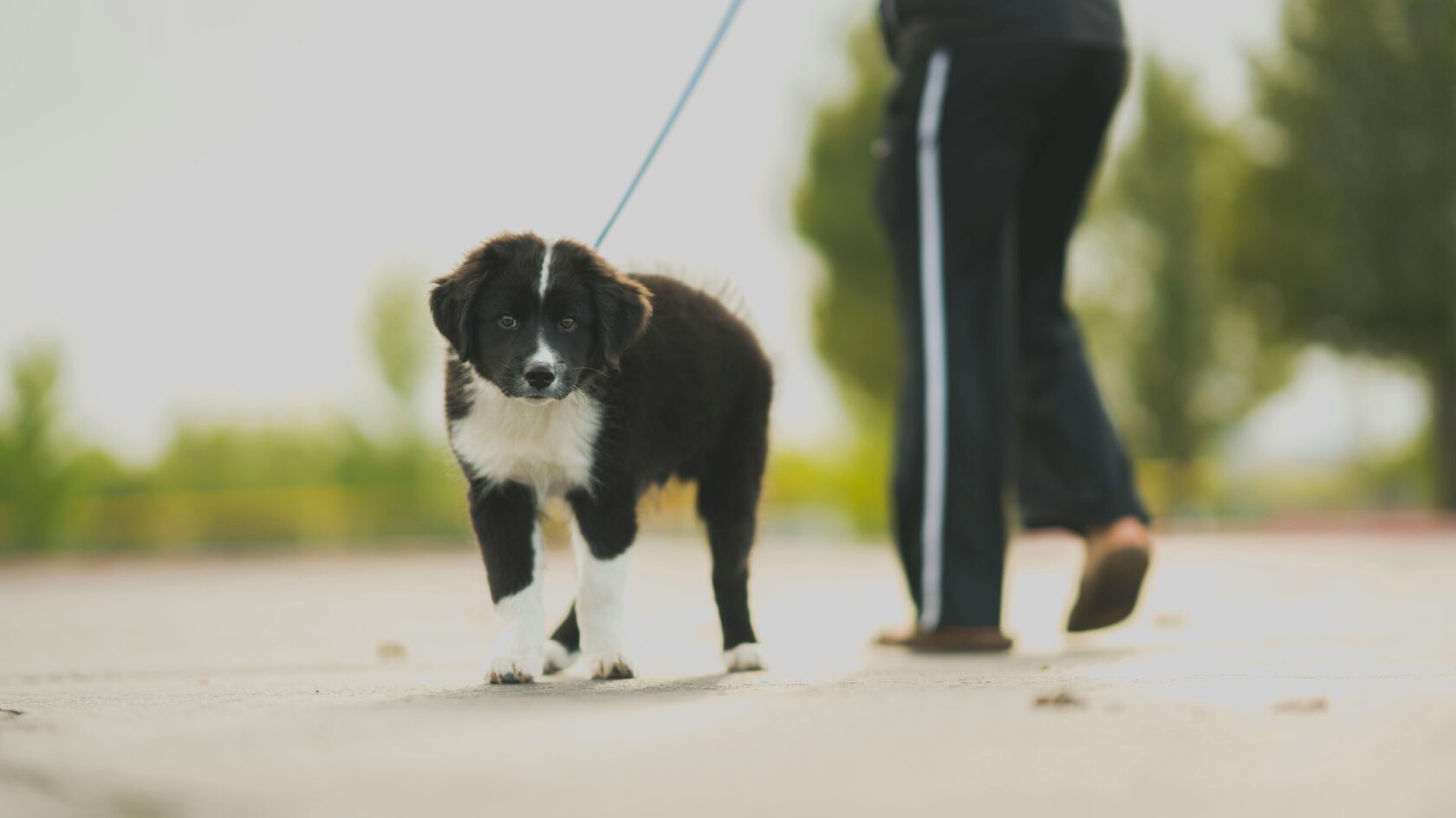
The rule of thumb is 5 minutes of walking per month of age — several times a day. So a three-month-old puppy needs around 15 minutes of exercise per outing.
That doesn't mean it should stay home the rest of the time — short outings several times a day are healthier than one long walk.
Puppy walks are also time for: learning to walk on a lead, socialising with people and other dogs, exploring new scents and environments, and the first command exercises out in the world.
Adult dog (1–7 years)
A minimum of 3 walks a day, one of which should last at least 30–45 minutes. Total physical activity should be 60 to 90 minutes a day — though active breeds (husky, labrador, malinois) may need up to 2 hours of exercise. It's worth remembering that a walk isn't just about marching — play, running and sniffing count just as much as distance covered.
Senior (over 7–8 years)
Older dogs are often still happy to go on longer walks, but need a calmer pace. Instead of one long outing, shorter, more frequent walks work better — 3–4 times a day for 15–20 minutes. Watch your dog: if it slows down, sits, or limps, that's a signal to shorten the route.
How many walks does a dog need depending on its breed?
Breed is one of the most important factors. Here's a rough breakdown: Breeds needing a lot of exercise (90–120 minutes a day): border collie, Siberian husky, malinois, labrador retriever, golden retriever, jack russell terrier, dalmatian, pointer, springer spaniel.
Breeds with medium exercise needs (60–90 minutes a day): German shepherd, boxer, cocker spaniel, beagle, Irish setter, shiba inu.
Breeds with lower exercise needs (45–60 minutes a day): English bulldog, French bulldog, pug, shih tzu, chihuahua, basset hound, cavalier king charles spaniel.
Remember, though, that every dog is different — even within the same breed, temperament and energy levels can vary considerably. Always watch your own specific dog, not just breed statistics.
What to do when you don't have time for enough walks?
Not everyone can guarantee their dog an hour-long walk every day — work, travel and other obligations are a reality. But that doesn't mean your dog has to suffer from boredom and frustration.
In such situations it's worth considering support from a caregiver: a dog walker can walk your dog during the day when you're not there — especially good for dogs left alone for many hours; a petsitter can take care of your dog comprehensively while you're away — walks, feeding, company and a daily report with photos; doggy day care — the dog spends the day in a group of other dogs with a caregiver, meeting both exercise and social needs.
Regular walks with your dog are an investment — in its health, calm and your relationship. A dog whose need for exercise is met is calmer, more obedient and happier. And honestly — owners who walk their dogs regularly benefit from it too.
Length isn't everything — walk quality matters
Even if you only have 30 minutes a day, you can organise a walk that will genuinely tire your dog out and meet its needs.
Key elements of a good walk: sniffing — let your dog smell the world at its own pace; it's its natural way of exploring its surroundings and one of the strongest mental stimulators.
A dog that sniffs is working its mind hard — studies show that 20 minutes of free sniffing tires a dog more than an hour-long march; changing routes — new places mean new stimuli and better mental fatigue; short training sessions — a few commands rewarded with a treat engage a dog more than the route alone; free exploration — on a longer lead or in a safe off-lead area if you're confident in your dog's obedience; social contact — meeting other dogs and people is an important part of a dog's mental health, especially for sociable breeds.
Walking and a dog's mental fatigue — why walking alone isn't enough
Many owners focus solely on the distance and duration of the walk, forgetting a dog's mental needs. A dog is an animal that, over thousands of years of evolution, worked — tracked, guarded, hunted.
A lack of mental stimulation leads to the same problems as a lack of physical exercise. How to tire a dog out mentally during a walk?
Scent games outdoors — hide a treat in the grass and have your dog search for it; obedience training in a new place — this is significantly harder than at home and quickly engages the dog; walking on different surfaces — grass, gravel, sand, wood — this is proprioceptive stimulation of the nervous system; meeting new people and dogs — especially important for puppies during the socialisation period.
Signs of too little exercise — what to watch for?
Dogs that don't get enough activity often signal it through their behaviour.
It's worth knowing that most behavioural problems in dogs stem precisely from a lack of exercise and stimulation: excessive chewing of furniture and objects, jumping on household members and difficulty calming down, howling or barking for no obvious reason, excess weight and lethargy, destroying things while the owner is away, excessive licking of paws or other surfaces, hyperactivity and inability to focus attention.
If your dog shows these behaviours, the first step is to increase its daily dose of exercise and mental stimulation — before turning to other solutions or a behaviourist's advice.
FAQ — walking a dog
Can a dog go out just twice a day?
Two outings is the absolute minimum, and for most dogs it's clearly not enough. An adult dog needs at least 3 walks a day to meet its physical and mental needs. With only two outings you risk frustration, behavioural problems and excess weight. If you can't manage three outings, consider help from a dog walker.
How many walks a day does a puppy need?
A puppy should go out 4–5 times a day for short walks — following the rule of 5 minutes per month of age. Frequent, short outings are healthier for developing joints than infrequent, long marches.
Does the length of a walk depend on the dog's breed?
Definitely. Working and sporting breeds (border collie, Siberian husky, jack russell terrier) need 1.5–2 hours of activity a day. Calmer breeds (bulldog, shih tzu, pug) can be content with 45–60 minutes. Always watch your specific dog — individual temperament can matter more than breed standards.
What should you do when it's raining or very hot?
In rain, most dogs happily go out for a shorter walk — it's worth investing in a good raincoat. In heat, walk in the morning or evening, avoid hot asphalt and shorten the route. Never leave a dog in a hot car.
Can a walk replace play at home?
Not entirely — a walk and play at home meet different needs. A walk gives a dog external stimuli, sniffing and movement. Play at home builds the relationship with the owner and engages the mind. An ideal routine combines both.
How can you tell if a dog gets enough exercise?
Watch your dog's behaviour at home. A calm dog that rests happily, doesn't destroy things and doesn't demand constant attention — that's a sign its needs are being met. A dog that's agitated, chewing, barking for no reason or hard to calm down is signalling that it needs more activity.
The length of a dog's walk depends on age, breed and temperament — there's no single universal answer. More important than the number of kilometres is the quality of the outing: the chance to sniff, explore and engage with the surroundings.
If you can't provide your dog with the right dose of exercise, it's worth using the help of a dog walker or petsitter. What matters most is regularity, observation and matching the walk to your dog — because a dog whose exercise needs are met is calmer, healthier and happier.